
Pembroke Pines, FL · Garage Door Service
What Happens to Your Opener When the Power Drops
Pembroke Pines homes built 1953-2005 often run openers with no battery backup. Here's what a power outage actually does to your door and when to fix it.
- Repairs & new doors
- Springs & openers
- Serving 7 nearby communities
Doing Nothing For Now
If your opener still runs fine and the power only blinks for a second or two, you don't need to do anything today. A lot of homeowners in this service area are sitting on openers original to houses built anywhere from 1953 to 2005, with the typical build year landing around 1972 - and plenty of those units have worked for decades without a battery backup and without trouble. Waiting is a reasonable call if the door opens, closes, and the remote still works after the lights come back on.
Where it stops being reasonable is if you've already noticed the door won't budge at all when the power's out, and you don't know where the manual release cord is or how to use it. That's not a maintenance item, that's a safety gap. Here's the honest limit on our end: we don't stock every battery backup module for every opener brand made since the 1970s, so if yours is an older or less common unit, there can be a short wait on the right part. We'd rather tell you that up front than promise same-day on something we don't have on the truck.
What the Weather Here Does to It
Pembroke Pines sits in a mild temperate band, which actually works in your favor compared to places that deal with hard freezes. You're not fighting ice-locked tracks or a torsion spring that's gone brittle from a cold snap, and the opener's motor and gears aren't cycling through the kind of freeze-thaw stress that cracks housings up north. That's one less thing to worry about with equipment that, across this area's housing stock, is often older than the owner realizes.
What the mild climate doesn't change is what happens the moment power outages out, regardless of season. The opener loses its sensors, its logic board, its motor - all of it, at once. A storm doesn't have to be severe to trip a breaker or black out a block for a few minutes, and when that happens the door is wherever gravity and the spring tension leave it. In a mild climate the mechanical parts themselves age slower, but that doesn't mean the electrical side is any less exposed when the grid hiccups.
What Is Going On
Across the 41 named areas this type of housing stock spans - from here out toward Southwest Ranches and up toward Miami Lakes - most garage doors were paired with openers installed when the house itself went up, commonly sometime in the 1960s or 70s. Those units predate the point where battery backup became a standard feature rather than an upgrade. So when the power outages, the opener simply stops. No backup kicks in, no slow descent, nothing. The door sits exactly where it was in the cycle, locked in place by the opener's own gearing until power returns or someone pulls the manual release.
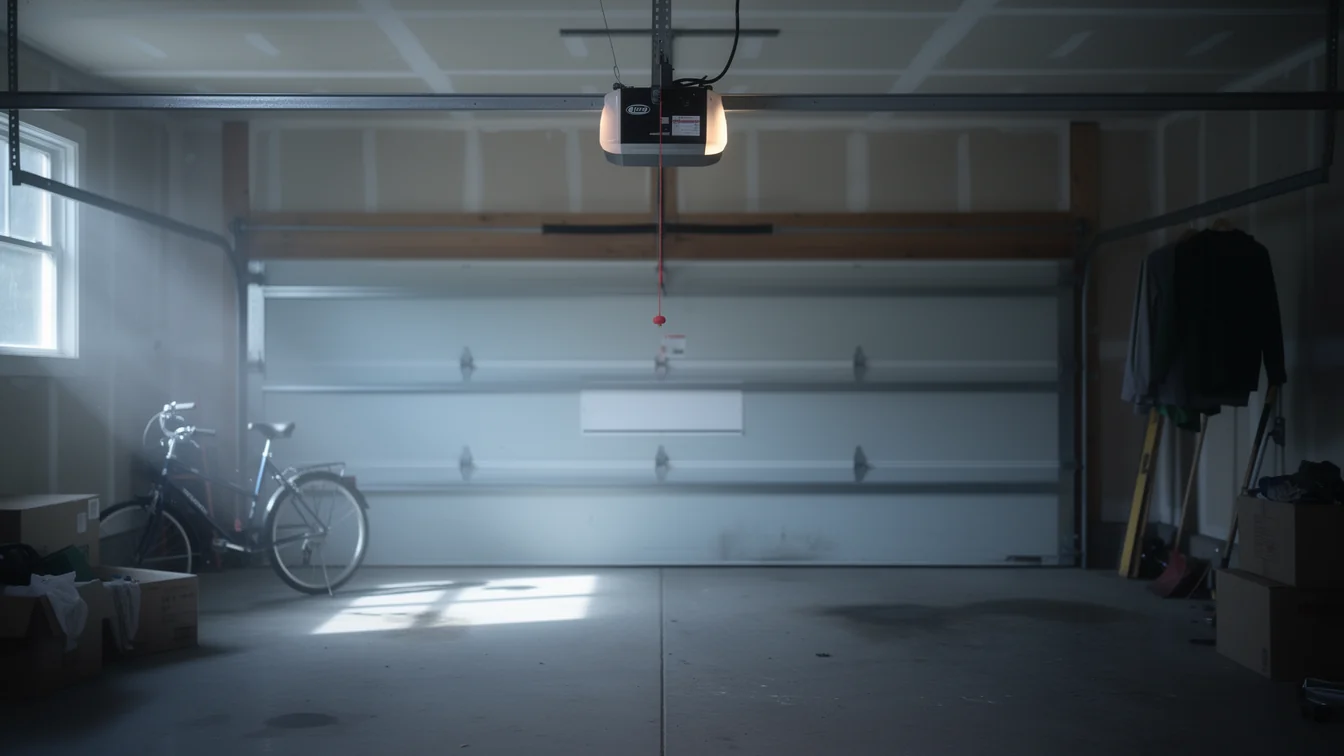
With 467,536 households and 122,711 owner-occupied houses across this service area, that's a lot of garages running on hardware from that same build era. It's not a defect, it's just the generation of equipment that came with the house. The manual release handle - usually a red cord hanging from the trolley - disconnects the door from the opener carriage so you can lift it by hand. On original 1960s-70s installs, that cord is sometimes hard to reach or has never been pulled once since the house was built.
What Most People Get Wrong
The biggest mistake is assuming the manual release will work the same on an older opener as it does on a newer one. On a lot of the chain-drive units that match this area's median 1972 build year, the release mechanism is stiffer, and pulling it wrong can jam the trolley instead of freeing it. People find this out for the first time during a power outage, which is the worst moment to learn it.
The second thing folks get wrong: they think a battery backup unit is something you bolt onto any opener. It isn't. Compatibility depends on the opener's age and model, and on houses built well before backup batteries were common, the motor unit itself sometimes needs to be swapped rather than retrofitted. Given a median household income of $60,979 in this area, that's a real cost decision, not a given - we'd rather walk through whether your specific opener can take a backup add-on before anyone spends money assuming it can.
Frequently asked questions
Will my garage door opener work at all during a power outage?
Not unless it has a battery backup, which most openers original to older Pembroke Pines homes don't. Without one, the motor has no power and the door stays wherever it was. You can still move the door by hand using the manual release cord on the trolley.
Can any opener take a battery backup add-on?
No. Compatibility depends on the opener's age and model. Units from the 1960s-70s build era common in this area sometimes can't accept a bolt-on backup and need the whole motor unit replaced instead. We check the specific model before recommending either option.
Does the mild Pembroke Pines climate affect my opener?
It helps on the mechanical side - no freeze damage to springs or tracks like colder regions see. It does nothing for the electrical side, though. A power outage takes out the opener's circuit board and motor the same way regardless of outside temperature.
Related garage door services in Pembroke Pines
More garage door guides
Book garage door service in Pembroke Pines
Call now or request a quote - tell us what the door is doing and where you are.