
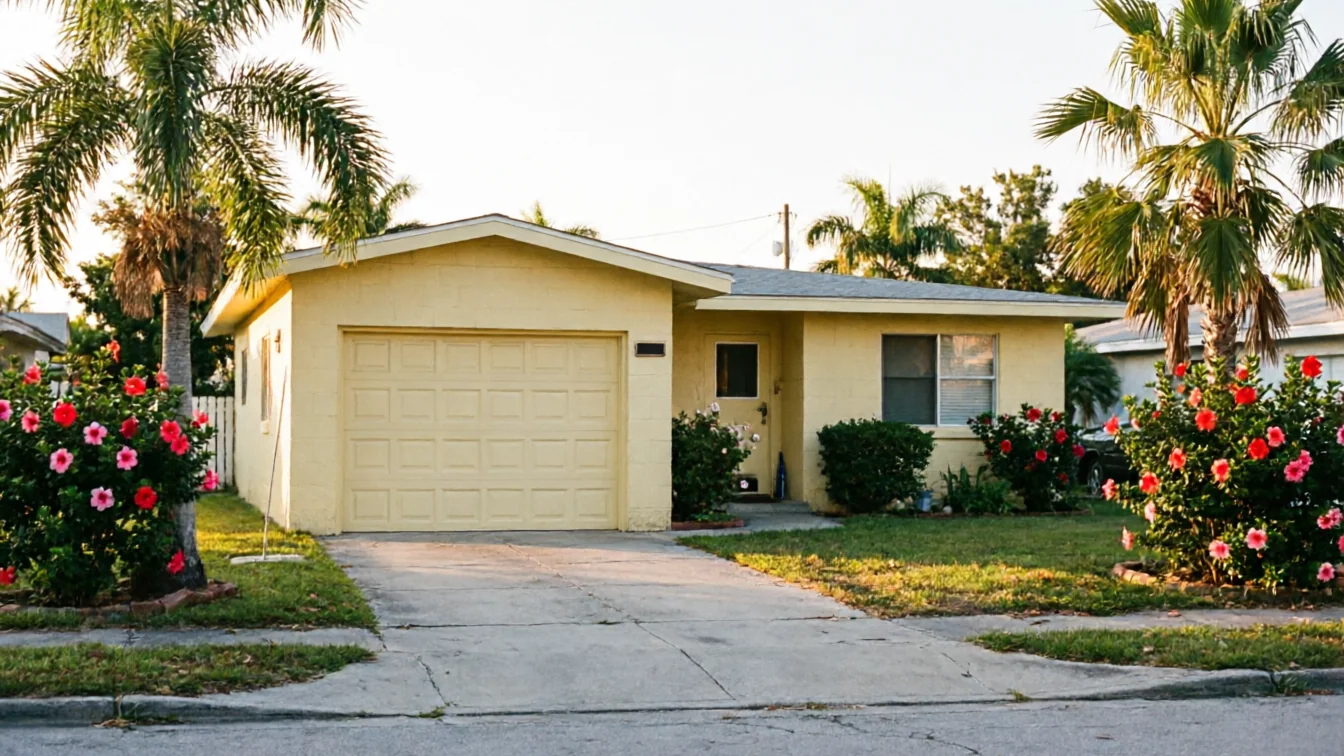
Pembroke Pines, FL · Garage Door Service
Garage Door Repair in Tamiami, FL
Tamiami's housing, mostly built after 1985, needs different garage door parts than older stock. Pembroke Pines Garage Door Pros services repairs, 18 miles out
- Repairs & new doors
- Springs & openers
- Serving 7 nearby communities
What the Housing Means for Your Door
The first thing that matters here is the build date, not the zip code. Across the wider service area the median home went up around 1972, but Tamiami's own median sits closer to 1985 - a full decade-plus newer. That gap changes what's actually failing on your door.
Homes from the early-to-mid 1980s almost always came with steel sectional doors on torsion springs rather than the older extension-spring setups still common in the oldest pockets of the territory. If your door is original, you're not dealing with the single dangerous spring-under-tension problems we see on 1960s builds - you're dealing with 40-year-old torsion hardware: drums that have worn grooves, a torsion tube that's starting to flex, bearing plates that have gone dry. Openers from that era were usually chain-drive and have likely already been swapped once.
We can't tell you which exact year your subdivision went up without seeing your door - 1985 is the area's median, not every house's birth year. But if your door still has the original hardware, the torsion spring and the bearing plates are the two spots worth a look before anything else.
Old Streets and New Ones
The broader territory we cover is a patchwork - mostly 1960s and 1970s stock spread across dozens of named areas, with build years running from the early 1950s up through the 2000s. Tamiami sits on the newer end of that range. That matters for parts.
On the older streets elsewhere in the territory, we still run into one-piece doors, side-mounted torsion setups, and openers that predate anything you can special-order a replacement remote for. Tamiami doesn't have much of that. A door built around the area's 1985 median is sectional, steel, and torsion-sprung as a near-default, which means the common failure points - roller wear, cable fray, a cracked bottom panel - are repaired with parts that are still in normal supply, not hunted down.
The honest tradeoff: a more uniform build era means fewer surprises on the hardware, but it doesn't mean fewer calls. A 1985 door is still close to 40 years old. Springs and cables don't last indefinitely regardless of what decade the slab was poured.
This Area's Housing
Tamiami has roughly 17,676 households, and the median household income here runs about $78,916 - well above the $60,979 median for the service area as a whole. That income gap shows up in the calls we get: more owners here ask about full opener replacement with battery backup and belt drives rather than the cheapest chain-drive fix, and more ask about insulated steel doors over the bare single-skin panels still common on older stock elsewhere in the territory.
Climate-wise, this falls in the same mild temperate band as the rest of the territory - no hard freezes to worry about, no deep snow load on the door. The wear here comes from steady humidity and sun exposure on seals and weatherstripping rather than winter stress on springs. Rubber bottom seals and vinyl glazing on windowed panels tend to go first, well before the steel itself fails.
Across the wider service area there are about 122,711 owner-occupied houses among 467,536 households total. Tamiami's own household count is a small slice of that, which is part of why we schedule by route rather than by neighborhood.
Timing on This Area
We run out of Pembroke Pines, and Tamiami is about 18 miles from there. We don't keep a depot or a truck staged in the area, so we're not going to promise a same-day window the way a shop five minutes away might. What we can do is build the drive into the schedule honestly rather than pad the quote to cover it.
If your spring snaps and the door won't move at all, say so when you call - that's a different priority than a noisy opener or a slow-closing door that still works. Jobs that need a part we don't carry on the truck (certain opener boards, some odd-width torsion springs) may need a second trip once the part's in hand; we'd rather tell you that up front than show up and discover it on your driveway.
Booking a day ahead when it's not an emergency gets you a tighter window, since the 18-mile stretch means we're routing a few stops a day out this way rather than circling back and forth.
Frequently asked questions
Do you have a shop or office in Tamiami?
No. We're based in Pembroke Pines, about 18 miles away, and we drive out for jobs rather than keeping a local depot. That distance is why we ask for a little lead time on non-emergency calls, though we still handle broken springs and stuck doors as priority.
My house was built in the 1980s - does that change what's wrong with my door?
Usually. Homes from Tamiami's build era typically came with steel sectional doors on torsion springs, not the older one-piece or extension-spring setups common on 1960s houses elsewhere in the territory. At 35-40 years old, the usual failures are worn torsion bearings, stretched cables, and dried-out rollers rather than obsolete hardware.
Does the local climate cause specific garage door problems?
The mild temperate conditions here mean you're not fighting freeze damage or heavy snow load. The wear we see is steadier and slower: UV and humidity breaking down rubber bottom seals and window glazing on panels over years, rather than a sudden weather event taking out a spring.
Is it worth replacing an opener from the original 1980s installation?
If it's chain-drive and original, it's almost certainly already been replaced once or is close to needing it - these units don't run 40 years. Given the income and home values in this area, a lot of owners here choose to upgrade to a belt-drive unit with battery backup rather than a bare like-for-like swap, but that's a budget call, not a requirement.
Garage door services in Tamiami
Every service our crew runs in Tamiami, FL.
Book garage door service in Pembroke Pines
Call now or request a quote - tell us what the door is doing and where you are.