
Pembroke Pines, FL · Garage Door Service
What's Really Going On With Your Spring in Pembroke Pines
Pembroke Pines homes mostly date to the 1960s-70s building boom. Here's why spring failure here tracks hardware age more than any cold snap.
- Repairs & new doors
- Springs & openers
- Serving 7 nearby communities
Doing Nothing For Now
If the door still opens smooth and the spring isn't visibly gapped or rusted through, you don't need to call anyone today. Watch for the obvious signs instead: a cable that looks frayed where it wraps the drum, a spring with a visible gap in one of its coils, or an opener that strains and groans on the way up. None of those mean the sky is falling, but they mean the clock is running.
What makes Pembroke Pines different from a brand-new subdivision is the age of the housing stock behind these doors. Homes here were built between 1953 and 2005, with most of the stock dating to the 1960s and 1970s building boom across the area's 41 named neighborhoods. A spring sized and installed during that era, or even a later replacement sized the same way, has had decades of open-close cycles to wind down toward failure. Waiting is fine. Waiting blind isn't. If your spring was last touched more than a few years back and you don't know its age, that's the one thing worth finding out before you decide to do nothing.
What the Weather Here Does to It
Pembroke Pines sits in a mild temperate band, not a freeze-thaw zone, so you're not dealing with the extreme swings that crack concrete or snap hardware outright. But mild doesn't mean nothing happens. On the handful of mornings each year when temperatures do dip, steel that's already fatigued gets measurably stiffer and more brittle right as the opener puts it through its first heavy cycle of the day. That's when a spring goes in cold weather around here - not from the cold itself, but because the cold finds the weak link that decades of cycling already created.
The reason this matters more here than it would in a newer market is the housing stock. So much of the area's hardware traces back to the 1960s-70s construction wave, meaning a lot of springs are either original or sized to match doors and openers from that generation. A mild climate hides fatigue longer than a harsh one would, because there's no hard freeze forcing an early failure. That just means the eventual break often lands on one of those few cooler mornings, catching people off guard after years of no trouble at all.
What Is Going On
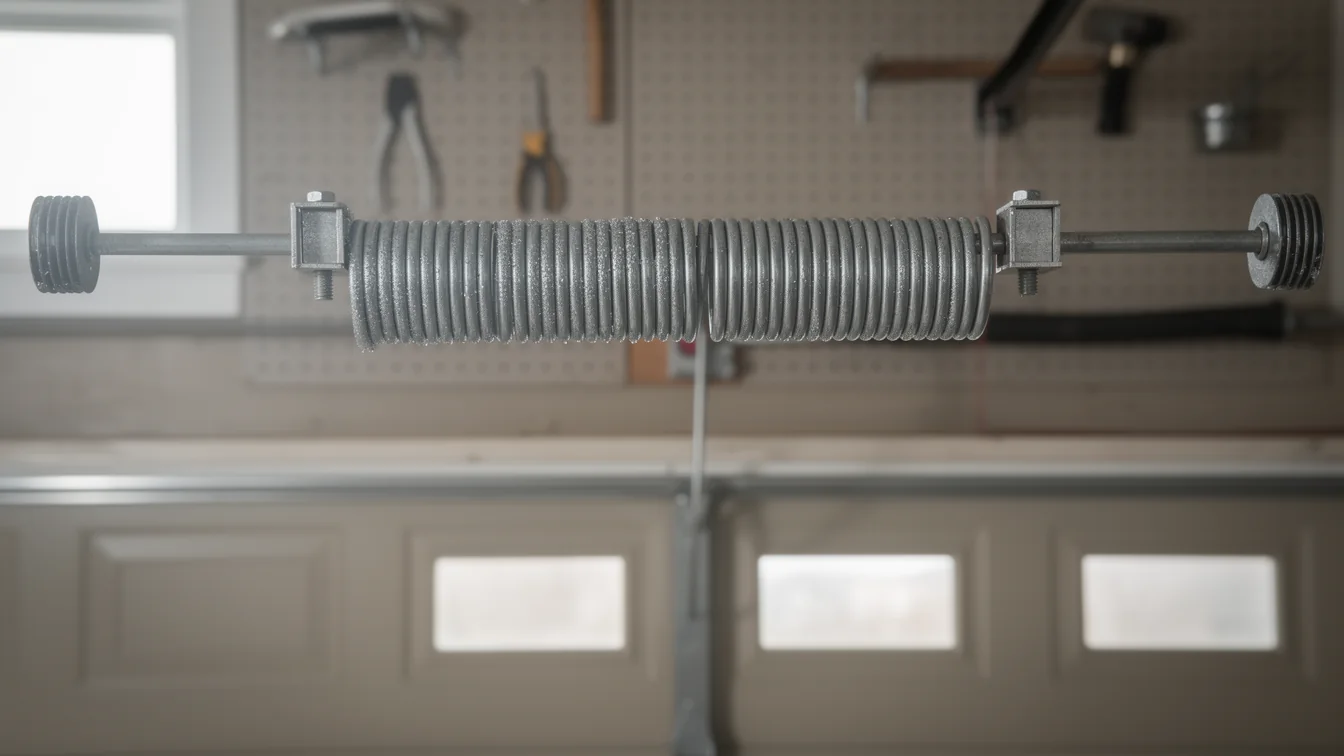
A torsion spring is rated for a set number of open-close cycles, somewhere in the tens of thousands depending on size and wire gauge. Every lift and drop winds and unwinds the coil a fraction more toward the end of that count. There's no warning light. It just gets weaker and weaker until one more cycle is the one it doesn't survive.
With a median build year of 1972 across this service area, a lot of these systems have had a very long runway. Some doors have had their springs replaced once already; plenty haven't. Either way, the original hardware era matters because springs installed decades ago were often sized to the door weight and opener horsepower standard at the time, not necessarily what's on the door now if panels or openers were swapped later. A spring that's technically still holding can be working harder than its rating intended, which shortens what's left of its life without anyone noticing until the morning it lets go.
What Most People Get Wrong
The most common assumption is that a cold morning broke the spring. It didn't start it - the fatigue was already most of the way there from years of cycling, and the cold just happened to be the final push. Blaming the weather alone means someone replaces the spring, changes nothing else, and is surprised when a cable or roller goes next, because the rest of the hardware is the same age and has been working through the same number of cycles.
The other mistake is assuming a broken spring means the whole door needs replacing. Most of the time it doesn't. A torsion spring is a contained, well-understood repair. Where it gets more complicated is if the spring was sized for an older, lighter door and someone's since swapped in a heavier insulated panel - then the repair isn't just a spring swap, it's a resizing job.
Here's the honest limitation: we can't tell you over the phone whether your spring is original, what gauge it is, or what it'll cost, because that depends on the door in front of us. Anyone who quotes a price before looking at the hardware is guessing.
Frequently asked questions
Why did my spring break on a cold morning when it's never been a problem before?
In Pembroke Pines, the cold itself rarely causes the break. A spring that's been cycling for years, often since the house's original 1960s-70s hardware, is already fatigued. A cooler morning stiffens the steel slightly and the first heavy lift of the day finds the weak point. The age of the spring is the real cause; the cold is just the trigger.
Do I need to replace both springs if only one broke?
We don't have a blanket answer without seeing the door, since it depends on the spring's age and how matched the pair is. A spring that's decades old and paired with one that just failed is usually close behind it in cycle life, which is worth asking about rather than assuming either way.
How do I know if my spring is original to the house?
If your home dates to the 1960s or 70s building wave common across this area and the hardware looks untouched, there's a real chance it's original or an early replacement. We can't tell you the exact age without inspecting the coil, gauge, and mounting hardware in person.
Related garage door services in Pembroke Pines
More garage door guides
Book garage door service in Pembroke Pines
Call now or request a quote - tell us what the door is doing and where you are.